We are aware that we may use “strange” terminology.
To ensure clear communication and collaboration with our clients, it’s essential to establish a shared understanding of key terms and processes.
We also know that technology can sometimes feel like a burden, with its complexities, frustrations and rigid rules.
But when it works seamlessly, it’s almost magical, isn’t it?
That magic is a testament to the dedication of the teams who manage it and the users who contribute to its success every day.
This resource offers a brief look at the role of IT in today’s business world, exploring management approaches that maximize its effectiveness and ensure it supports key business goals.
In today’s technology-driven world, IT teams and service providers are playing a vital role, partnering with businesses to unlock greater productivity and drive growth. Effective IT service delivery drives business performance and enables companies to consistently exceed customer expectations.
Because IT resources are so critical, the quality of IT service delivery significantly impacts a company’s efficiency, agility, competitive advantage and growth.
In the words of Jan Van Bon in IT service management: an introduction:
“Providers of IT services can no longer afford to focus on technology and their internal organization, they now have to consider the quality of the services they provide and focus on the relationship with customers ”.
It is therefore needed a structured approach that aligns IT with business objectives: defining resources, processes and results, reducing costs and risks, and improving the experience of users and customers.
Starting in the 1970s, information technology pioneers began developing disciplines, frameworks and guidelines that would eventually gain worldwide recognition and reach maturity in the 2000s.
Here’s a brief overview:
IT Service Delivery should be the ultimate goal of every IT team or service provider.
To achieve the goal, a delivery model (such as Break-Fix or MSP) and several key elements are needed:
IT is a major recurring expense.
Effective cost planning and management are crucial for IT teams and service providers to prevent overspending, optimize resource allocation and ensure positive user experience.
IT service availability measures the percentage of time a service is accessible.
Non-critical services often aim for 99% availability.
Critical IT services typically require 99.9% availability (meaning they can be unavailable for about 8 hours per year).
Vital services can have a downtime of just 5 minutes per year.
Discipline encompassing the planning, design, development, deployment and support of an organization’s IT services.
ITSM is a process-focused approach that connects IT activities with the people they serve.
IT teams manage technology, while ITSM teams optimize service delivery to meet organizational needs and exceed user expectations.
IT Service Management includes the following core processes:
Framework of established best practices for implementing IT Service Management in an organization.
First published in 1986 by UK government agencies, ITIL’s ownership transitioned to Axelos in 2014.
The latest iteration, ITIL 4, released in 2019, introduces the service value system.
This new model emphasizes co-creation and a holistic, value-driven approach, moving beyond traditional IT service management.
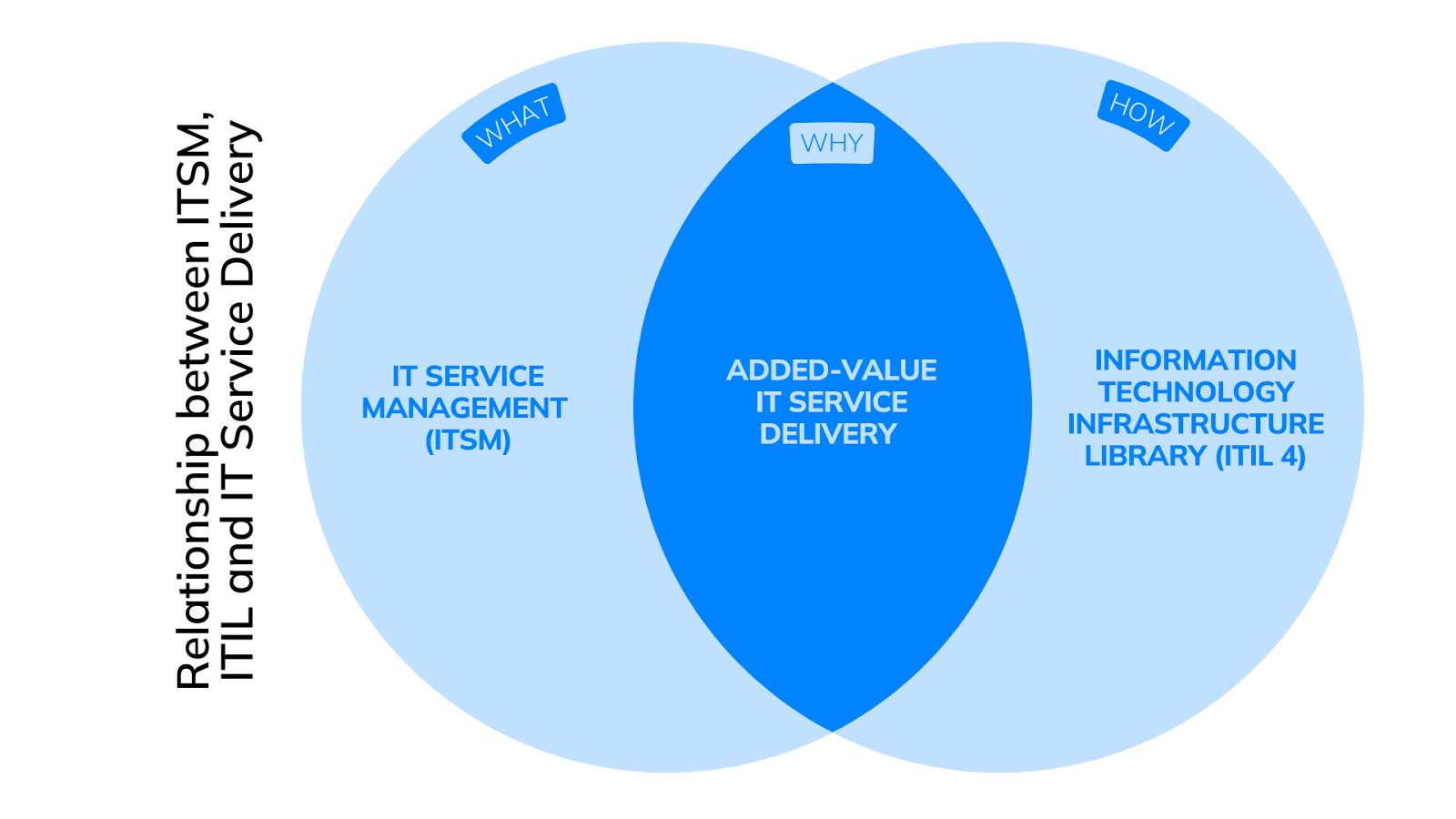
Relationship between IT Service Management (the “What”) and the Information Technology Infrastructure Library (the “How”) and IT Service Delivery (the “Why”).
This is the IT management approach we use at Techlane and for all our customers.
Curious about its effectiveness?