How many times have you said to yourself:
“Oh no, I have to write to IT to configure the software and I don’t have time to waste right now!”
or “I prefer not to even consult the IT department: I would spend 2 hours getting my head filled with technicalities, various tediousness about how important information security is and how complex it is to set up what I want, to justify their lack of action.”
We don’t get offended. That is the historical reputation that we partially still carry with us.
The reputation of those who unnecessarily hinder the business, of those who are uncooperative and always grumpy, of those who are unresponsive and speak an indecipherable language, of those who are detached from processes and live in their own world, where pragmatism does not exist.
A bit like in that hilarious scene from IT Crowd, where the brilliant Moss shows all his ineptitude in dealing with a fire, exclaiming: “I’ll just put this over here with the rest of the fire”.
From the British sitcom IT Crowd, Season 1, Episode 2
But, happily, things are much different now.
Developed in the 1980s as an official publication of the UK government agencies, ITIL is the globally recognized standard for IT Service Management:
set of best practices to guide IT service teams in maximizing the value of IT, ensuring alignment with overall business strategy.
ITIL 4 – released in 2019 – is its latest update. It represents a paradigm shift for IT teams and better reflects the reality of modern businesses. The guiding principles of ITIL 4 promote collaboration, simplicity and feedback, and guide IT teams towards a holistic business framework, oriented towards the creation of added value.
ITIL 4 recommends using technology to automate repetitive tasks and simplify processes. This empowers IT teams to prioritize the delivery of high-value services.
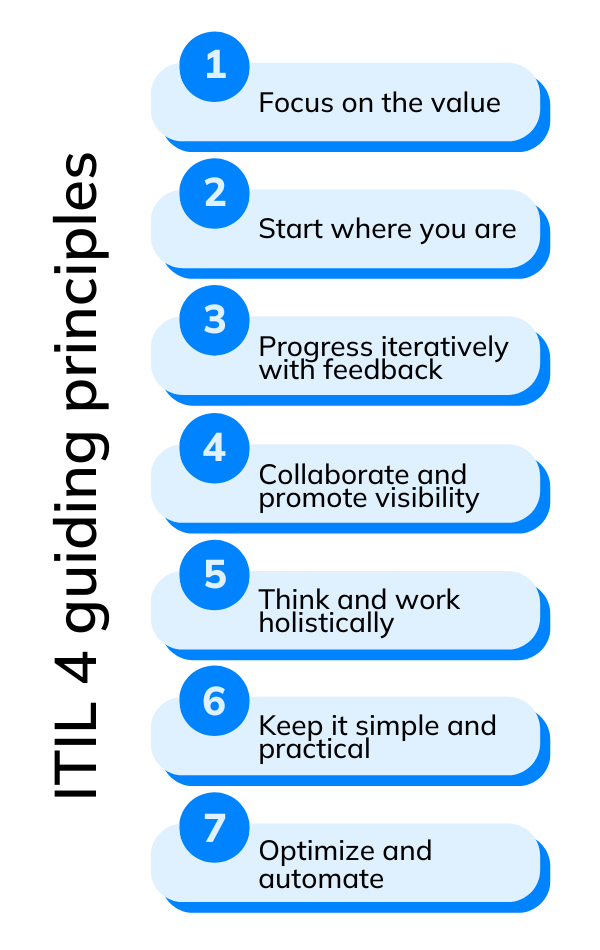
Figure 1. The 7 guiding principles of ITIL 4
As the first guiding principle states, the heart of ITIL 4 is the service value system: a model that emphasizes four essential factors for proper value co-creation (see Figure 2).
Figure 2. ITIL 4 Four-dimension model
We come to one of the operational methodologies that IT teams have available to co-create value: the priority matrix.
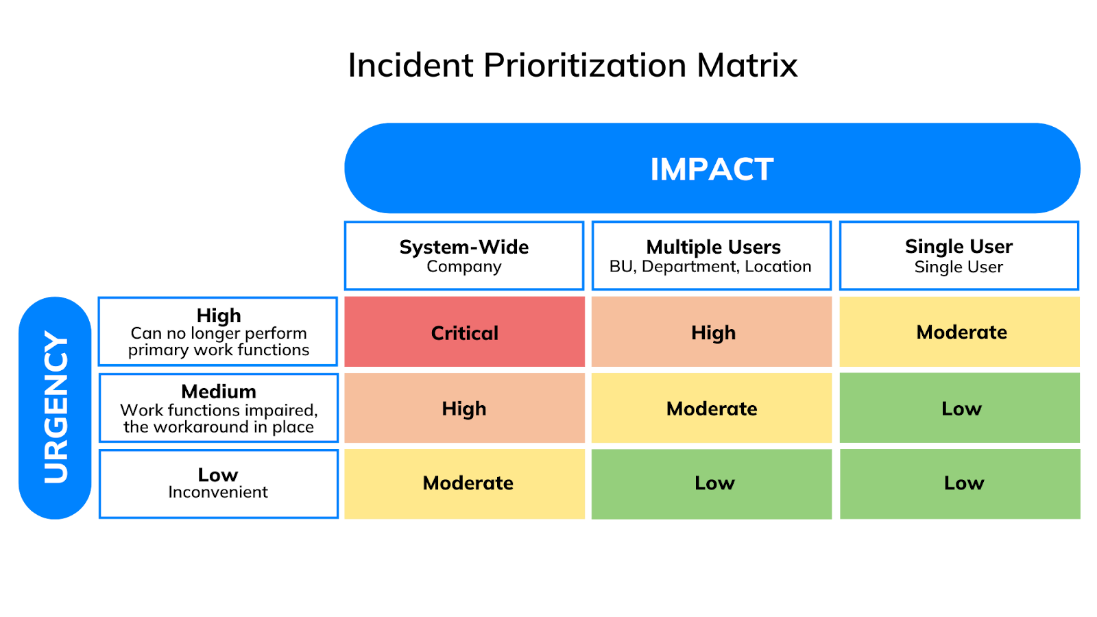
ITIL uses the priority model to determine the importance of requests sent to the service desk, to provide efficient services with a fair and unambiguous criterion and generate realistic expectations in users.
Before delving into the priority matrix, it is also necessary to define the 4 categories with which IT requests are differentiated:
Service request management is a less pressing process than incident and problem management, as nothing is broken or on fire.
However, it has an extremely enabling value, being the process that connects human resources to new technologies.Change Management is the practice of examining potential changes to ensure they are in the best interest of the company.
To this end, they need to be planned.Returning to the priority model, the matrix is applied to all categories – although it has greater relevance for Incidents – and is based on impact and urgency.
Impact and urgency combine in the matrix (see Figure 3), generating 4 levels of priority: 1 represents the highest priority (wide impact and high urgency) and 4 the lowest (individual impact and low urgency).
Figure 3. Incident Prioritization Matrix
The relationship between Priority and Service Level Agreement (SLA) is crucial.
SLAs define the expected level of service for incidents, problems, and service requests.
They outline specific metrics like:
The connection with Priority Levels lies in how SLAs are applied to requests of varying priorities:
In essence, priority levels guide how the IT team allocates its resources and ensures that the most critical issues are addressed promptly, aligning with the service expectations outlined and formalized in the SLAs.
Critical incidents, in fact, are managed first.