Best practices for secure AI service adoption in business
It's an extremely powerful, revolutionary, and now immensely popular tool. Understanding the basics of AI is essential for using it critically and to your advantage

Updated on : 08/05/2025
Published on : 30/04/2025
1. Protection of trade secrets and confidential information
-
Know the fundamentals of AI to use it critically
You don’t need to reinvent yourself as a data scientist, but it is essential to have a basic understanding of how AI models work to use them critically and consciously. -
DO NOT insert or allow access to sensitive or proprietary data
AI services such as the free versions of ChatGPT, Gemini, Perplexity, and Copilot often use user prompts to further train their models.
This means that the data you enter – product ideas, business strategies, data covered by NDAs, non-public financial data, proprietary source code, etc. – may not remain confidential and could enter future training datasets, becoming accessible to third parties.
Furthermore, consider that the interfaces for accessing artificial intelligence are already numerous and not limited to stand-alone chatbot apps: extensions and plug-ins, integrations in online software and search engines (see Screenshot 1), not to mention the countless mobile applications that integrate AI services and which often require unconditional and uncontrolled access to the data contained on mobile devices.

Screenshot 1. AI Overview integrated in Google Search
-
Carefully read the Terms of Service and Privacy Policies of the AI services you intend to use
Before using any AI tool, it is essential to understand how the provider handles the data provided to it.
Where is the data stored? How long is it retained? Is it used for training? Is it shared with third parties? Most free services offer few guarantees of confidentiality for the data entered.
For your convenience, below are the links to the Terms of Service and Privacy Policies of the main AI providers:
Open AI, Data usage for Chat GPT
Open AI, Europe Privacy Policy
Google, Gemini Apps Privacy Hub
Google, Generative AI in Google Workspace Privacy Hub
Google, Gemini Safety Center
Microsoft, Copilot AI Experience Terms
Microsoft, Data, Privacy and Security for Microsoft 365 Copilot
Microsoft, Data, privacy, and security for web search in Microsoft 365 Copilot and Microsoft 365 Copilot Chat
Microsoft, AI security for Microsoft 365 Copilot
Microsoft, Enterprise data protection in Microsoft 365 Copilot and Microsoft 365 Copilot Chat
Microsoft, Microsoft Privacy Statement – Artificial Intelligence and Microsoft Copilot capabilities
Perplexity, Perplexity Terms of Service
Perplexity, Perplexity Pro for Enterprise | Terms of Service
Perplexity, Perplexity Privacy Policy
Perplexity, Perplexity Security Hub
Perplexity, Perplexity Trust Center
Antrophic, Claude Consumer Terms of Service
Antrophic, Claude Commercial Terms of Service
Antrophic, Privacy Policy
Antrophic, Usage Policy
Antrophic, Trust & Safety Center -
Evaluate private AI solutions or using a controlled cloud environment
Consider adopting enterprise AI services (see Screenshot 2) that offer stronger guarantees regarding data processing, dedicated models, or the option to deploy AI on-premise or on a private cloud.
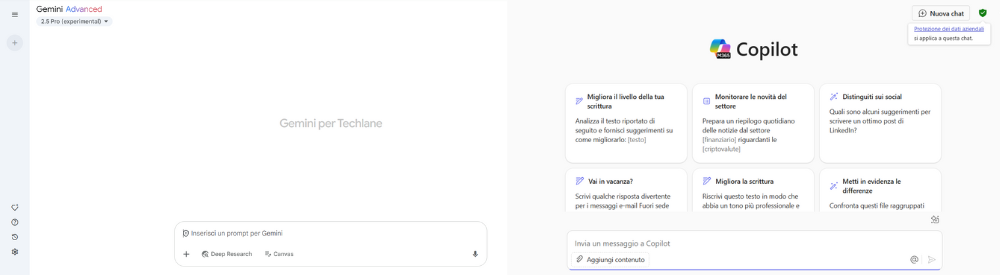
Screenshot 2. Gemini and Copilot business AI chatbot interfaces
-
Define clear internal usage policies
Establish rules for employees on using AI systems, specifying which tools are permitted and what types of data must under no circumstances be entered into public AI services.
In addition, consider providing specific professional training to your staff on the AI services you plan to use.